
The brand lifecycle: how to scale without disappearing
Sub-brands, acquisitions, branded houses, they all lead to the same multi-brand mess if nobody's managing the lifecycle.
In 2015, HubSpot had one product and one brand. Easy to understand. Easy to keep track of. Then Sidekick launched (it'd eventually become Sales Hub), and for some reason it needed its own sub-brand. Then HubSpot for Startups. Then a handful of ERGs each with their own sub-brand. Then more products. Then INBOUND. Before long there were double-digit sub-brands to keep track of and the brand team hadn't built most of them, didn't maintain most of them, and couldn't keep up with all of them.
Then the acquisitions started. Now it wasn't just sub-brands anymore, it was whole brands (beloved ones, like The Hustle) that couldn't just be shut down.
That was where the brand lifecycle first became obvious and it happens at almost every growing company on the planet.
“It happens to every company that grows. The question is whether it gets managed deliberately or discovered three years into the middle of it.”
What is the brand lifecycle?
Every company that scales moves through the same three stages, whether it takes five years or fifteen:
Core brand. One identity to start. A defined strategy, a set of guidelines (sometimes), and a single story that's easy to tell because there's only one of it.
Sub-brands. Growth shows up as more “stuff” — a new product, a conference, an education platform, employee resource groups, a newsletter, a podcast — and for reasons usually outside anyone's control, most of it ends up with its own sub-brand. Some look like the core. Some are barely recognizable at all.
Multi-brand. Sub-brands keep multiplying, and then acquisitions stack on top. There's no longer a single strategy anyone's following. Elements start bleeding across brands and sub-brands. Even the core brand starts to look a little off, because one story is competing with a dozen others being told at the same time.
And then it starts over. Eventually someone defines a new core brand and pulls the sub-brands and acquired brands back under one roof. Everything realigns. The company's on the same page again.
This isn't a failure. It's just what happens to every company that grows. The question is whether it gets managed deliberately or discovered three years into the middle of it.
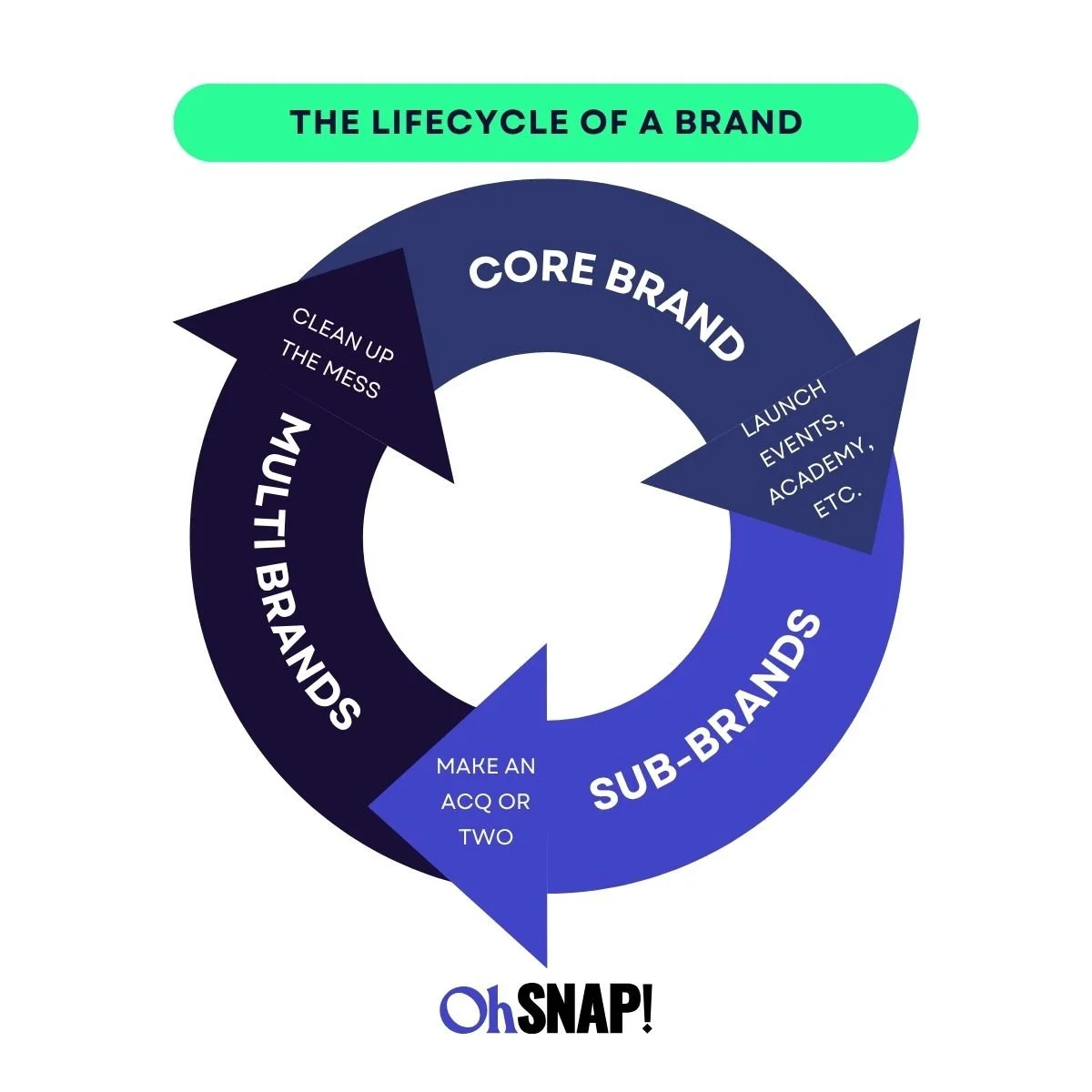
The brand lifecycle happens at almost every growing company. It starts with your core brand, then you move into sub-brands, then into multi brand, only to come back to a new core.
The multi-brand phase is where the acquisition tax lives
The sub-brand stage is annoying but cheap. The multi-brand stage — especially once acquisitions are involved — is where the real cost shows up. That cost has a name: the acquisition tax, the price of not thinking about brand integration until after the deal closes.
It's not the purchase price, the product integration, or onboarding the new team as those are (rightfully) planned from day one. But brand is the item that almost never makes the list, and the longer it waits, the bigger the bill.
Here's the part that catches most companies off guard: an acquisition doesn't just buy a product and a team, it buys an audience — customers who chose that brand because of what it was. The fastest way to torch the value just paid for is to slap a new logo on it and call it done.
Before that happens, a few questions are worth answering, ideally before the deal even closes.
Is the brand actually staying?
Sometimes the answer is no, and that's fine. Acqui-hires, good products with forgettable brands, long-term investments not ready for primetime, all of these happen.
For example, when HubSpot acquired Motion.ai, the deal was for the technology. That made the job simple: update the homepage to inform customers of the acquisition, add the sprocket, plan a deprecation timeline, done. No identity work, no hierarchy decision, just a clean off-ramp.
Where does the brand sit in the hierarchy?
If it's staying, this decision shapes everything downstream. There are four models to choose from:
Roll it in completely. The acquired brand disappears into the parent. Really this is the same as "not keeping it" — the customers stay, the brand doesn't.
Branded house. Every subsidiary carries the parent's full identity. Think FedEx. FedEx Ground, FedEx Freight, FedEx Express all look and feel like FedEx. Maximum consistency, minimum room for the acquired brand's own personality.
Endorsed brand. The acquired brand keeps real personality but sits under a clear parent relationship. Think Virgin Group. Virgin Atlantic and Virgin Mobile are obviously different businesses, but very clearly part of the same family.
House of brands. Each brand operates almost independently, connected only at the ownership level. Think Proctor & Gamble. Most people have no idea Tide and Gillette share a parent.
Most B2B companies live in option two or three. Option four is a luxury reserved for CPG portfolios (or PE firms) with completely non-overlapping audiences. Four isn’t a real strategy for B2B.
The Hustle is a good example of how this plays out in real time. A pure branded house would have stripped out the tone and irreverence that 1.5 million subscribers had signed up for, so that wasn't the fit here — a lesson the team learned by working through it, not by getting it right on the first try. The path that worked was an endorsed brand, built in three phases:
Phase one (months 1–6): Add the Sprocket next to The Hustle and Trends logos. Just enough to signal the relationship exists. Nothing else changes.
Phase two (months 6–12): Build a genuine hybrid sub-brand that moves The Hustle visually closer to HubSpot while protecting the personality the audience actually cared about.
Phase three (months 12–18): Finish the swing. Bring the visual system fully in line, and extend the relationship outward to the HubSpot Podcast Network, a relaunched YouTube presence, an expanded newsletter program, and so on.
Eighteen months, three deliberate phases, and the audience never felt like they'd been tricked. (Full breakdown in our HubSpot case study)
What happens to the website and the brand systems?
This is where the tax quietly balloons. Every acquisition inherits a web property which comes with it’s own series of questions: Where's it hosted? Whose budget absorbs that now? Is it built on a compatible tech stack? Is there a migration? Is it a handful of pages or thousands? And it inherits someone else's assets that now need a home in the Canva instance, the DAM, the design system, the CMS.
Managing two of everything indefinitely isn't a strategy, it's indecision. And the people joining from the acquired company are already uncertain about what's changing under them. Give them tools that work on day one instead of a PDF.
This happens to the biggest brands
Sinch, a global leader in communications infrastructure, grew almost entirely through acquisition — 22 brands and counting, including Mailgun, Mailjet, Engage, ClickSend, and SimpleTexting. Each came in with its own audience, its own identity, its own way of creating content, its own version of "how we do things here." It was 6+ core product brands with no shared architecture.
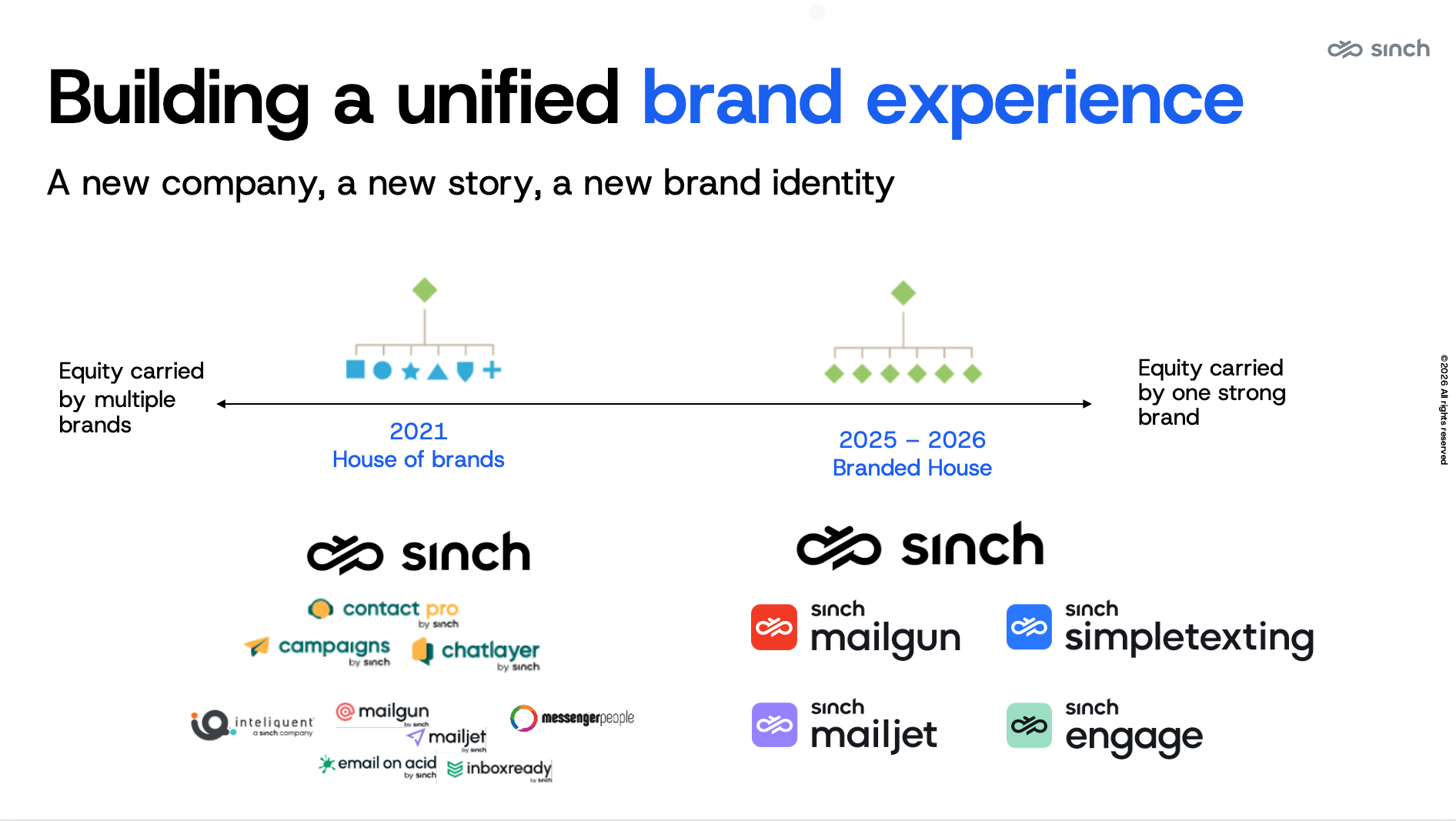
Sinch has acquired over 22 brands since 2016
OhSNAP! has been integral with the consolidation efforts, building the brand architecture that pulls those acquired brands into a coherent system without erasing what made each of them work for their own audiences. It's not a finished "look how clean this is" story yet (the work is still in motion) but that's exactly the point. Most companies live in the multi-brand stage for years before anyone commits to climbing back out of it.
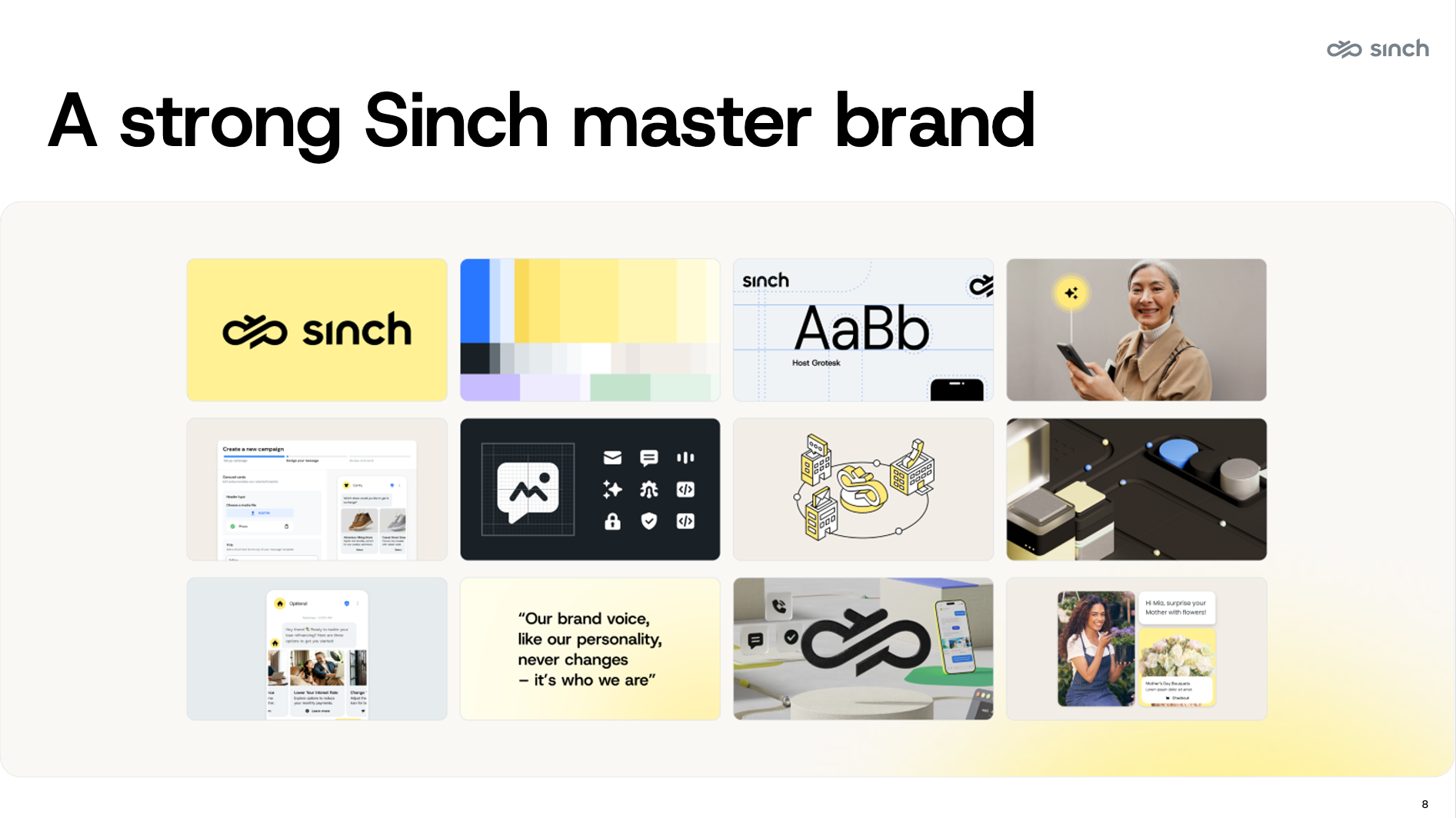
First came a rebranded parent brand for Sinch that the sub-brands could inherit from
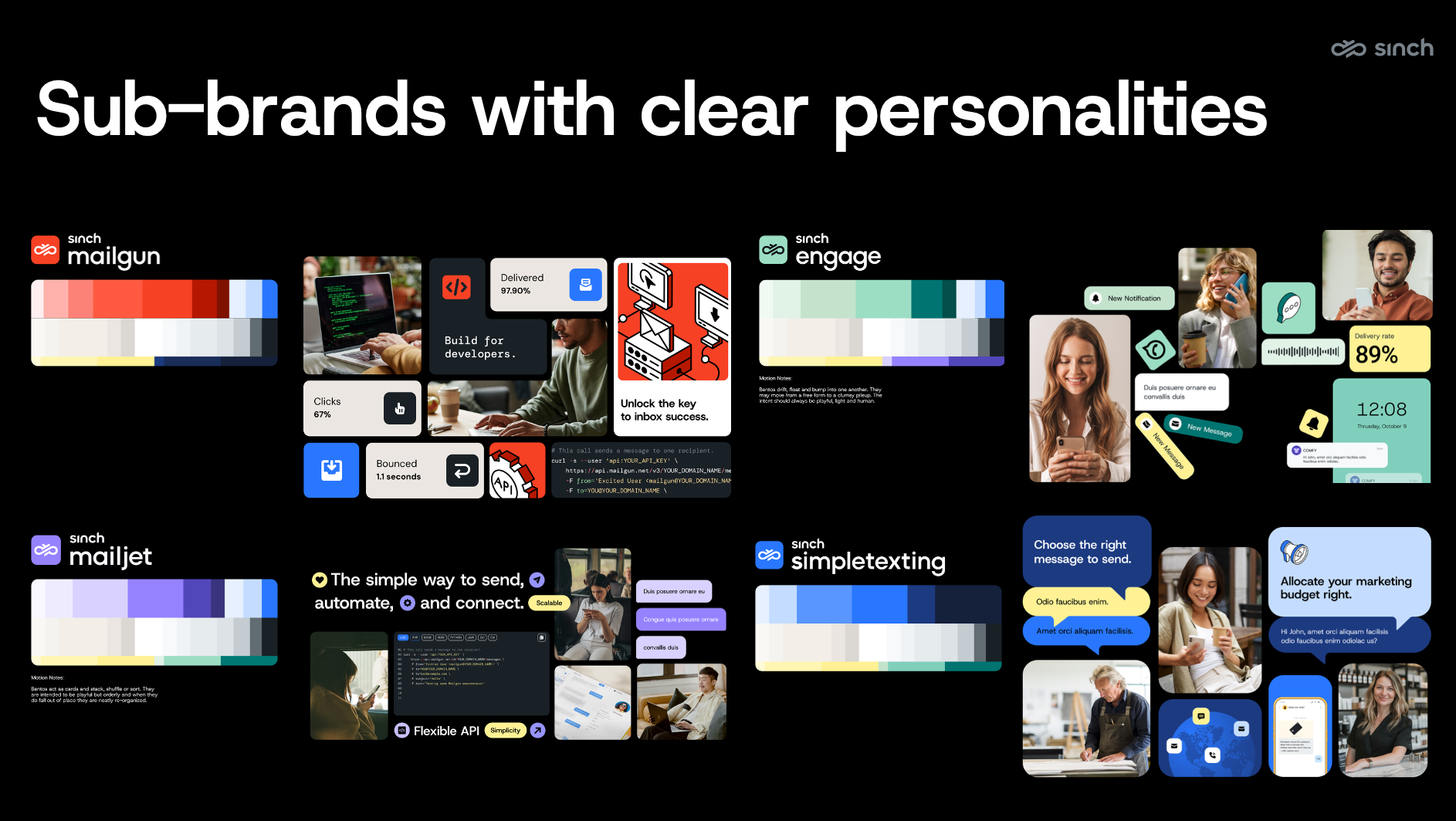
Then each individual sub-brand was able to be built with it’s own palette and personality while maintaining it’s connection to the parent brand
How to get ahead of the tax before an acquisition ever happens
The multi-brand stage is expensive no matter what, but how much of it is self-inflicted is very much controllable.
Set the rules for sub-brands before anyone tries to make one. Sub-brands usually come from ego (a project that feels bigger than everything else and wants to stand apart), uncertainty (a "skunkworks" idea nobody's sure will work, so it gets a different name to test the water), or need (sometimes you have something that’s actually different enough that it requires a sub-brand). These are all predictable.
Define what a sub-brand is allowed to look like (a wordmark, a secondary color palette, whatever is right for your brand) and put this guidance in the original brand guidelines before they’re ever needed.
Budget for brand before the acquisition closes, not after. Acquisitions take a long time to plan. They’re usually tricky to navigate and require a lot of “need to know” but your head of brand needs to know this is happening and should be putting a plan and budget together.
As a rough anchor, $50K–$200K depending on the size of the acquisition (it can go much higher) is a reasonable starting point, with brand direction sketched out as soon as the deal is rumored, not after it's announced.
Staff a pod, not a committee. Cross-functional, dedicated, small enough to move with representatives from the acquired company, the creative team, product if it's relevant. You need a working team with a deadline that owns this consolidation project.
Build a DACI before building anything else. Big cross-functional project, unclear decision rights — that's a recipe for every deliverable getting reviewed too many times by too many people. Decide who's driving, approving, contributing, and informed before a single decision gets made.
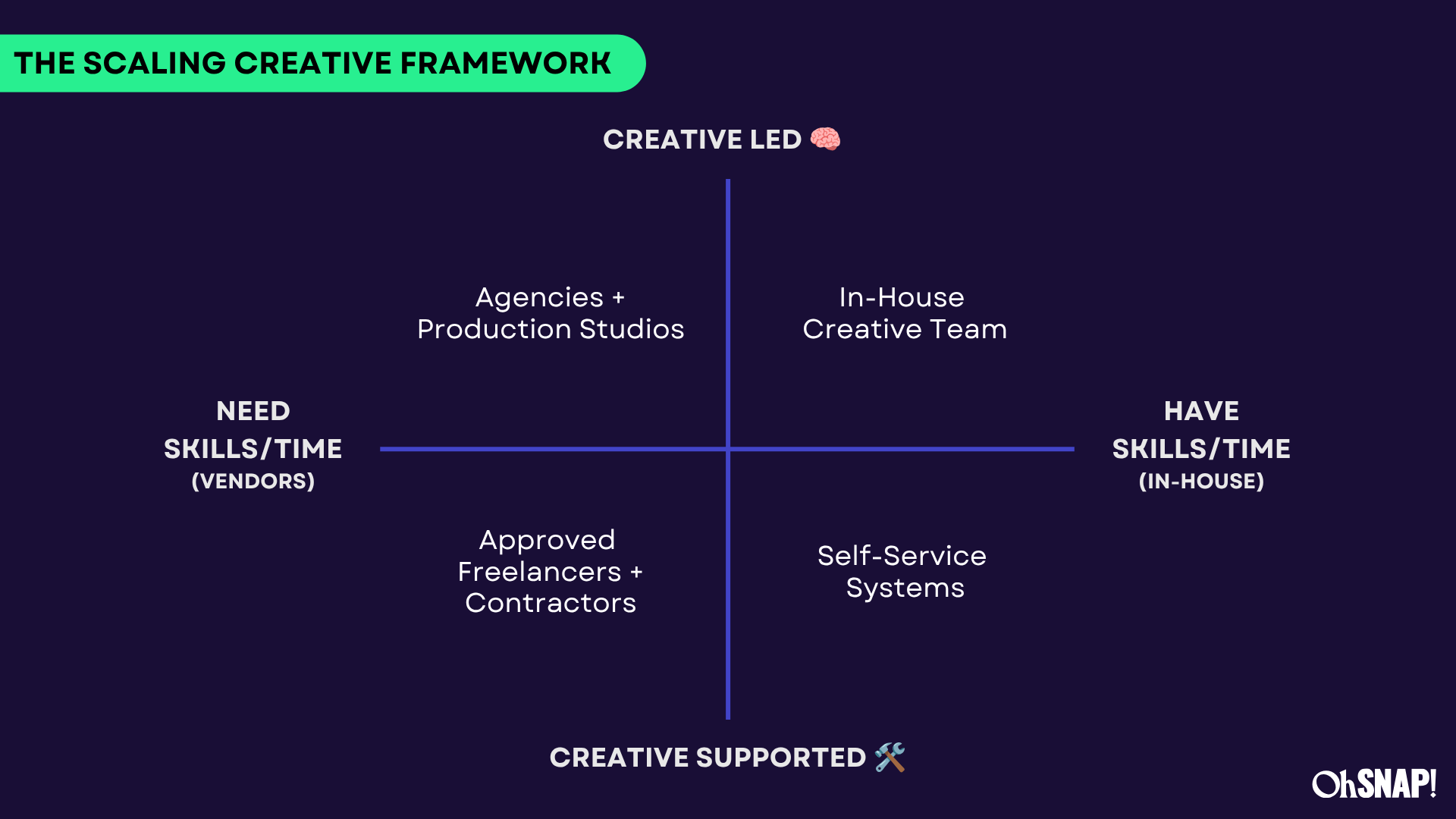
Know what to keep in-house and what to outsource. Map the work to The Scaling Creative Framework, the same way you'd map any creative request so that you can base things on internal skillsets and bandwidth. Building, rebuilding, and/or consolidating an existing brand is hard work and most teams can’t do it all in-house. Be clear about what you have the capacity to take on and outsource the rest.
The Scaling Creative Framework
In practice: brand strategy and architecture decisions are Creative Led and require someone who’s done it before (whether they’re internal or an embedded partner). Production design, content migration, and rebuilding the design system are Creative Supported, and that's where a team's own bandwidth usually runs out first.
Which stage is a company in?
Every company sits somewhere in this cycle right now — core, sub-brand, or already deep in multi-brand. The sub-brand stage can be controlled with enough discipline. The multi-brand stage is much harder to skip entirely, since it shows up the moment an acquisition happens or simply grows beyond it's core offering. The only real choice is whether it gets managed proactively or you have to react to it in the moment.
The pattern holds at every size: the earlier brand gets planned for, the smaller the tax. The longer it waits, the more gets paid in confused customers, duplicated systems, and blown budget.
Not sure which stage a company is in, or what consolidating out of it would even look like? That's exactly what a Brand Systems Audit is for.
OhSNAP! is a brand systems agency for modern B2B in-house teams. We build the strategy, the design system, and the tech stack — so your brand is usable on day one, not stuck in a PDF. Let's talk.
